
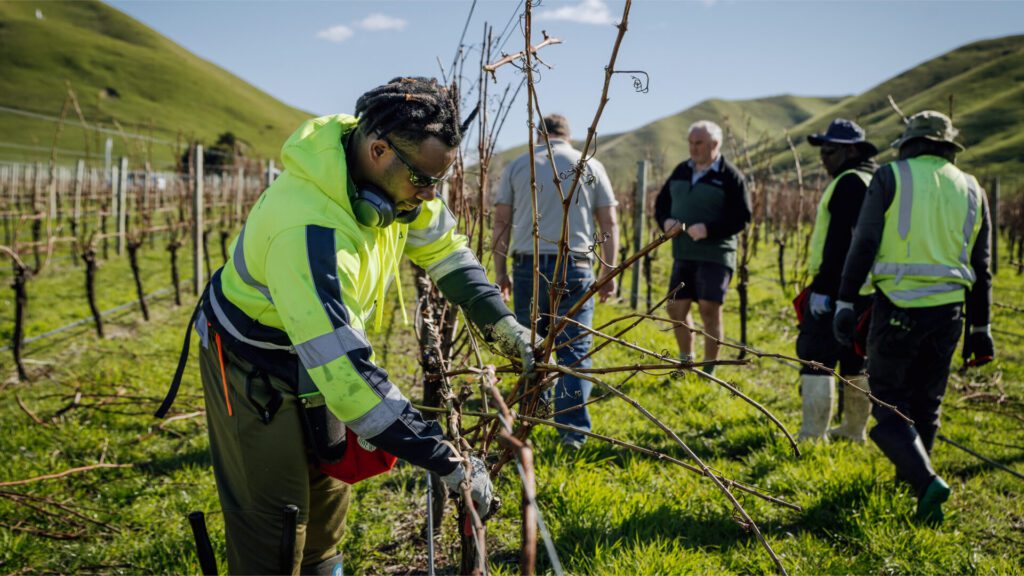
Labour mobility is no longer a marginal issue in the Pacific; it is one of the central pillars of regional development. As Professor Richard Bedford’s long-running work on New Zealand’s Recognised Seasonal Employer (RSE) scheme shows, managed temporary migration has become a structural feature of the relationship between Pacific states and our horticulture and viticulture industries in New Zealand (and Australia). Circular migration, with workers returning season after season, now underpins incomes and opportunities in countries such as Vanuatu, Fiji, Kiribati and Solomon Islands.
World Bank analysis reinforces this picture. Pacific workers participate in RSE (and Australia’s PALM scheme) because domestic labour markets are narrow and youth populations are growing, while overseas wages are many multiples of what can be earned at home. Earnings are used to smooth shocks, pay school fees, build houses and launch small businesses, and in aggregate they have become a significant development flow for several island economies.
At the same time, recent World Bank work on COVID-19 reminds us how vulnerable these gains are to border closures and policy changes, and how important it is to design schemes that are resilient to disruption.
Bedford and his colleagues have also been clear that labour mobility must deliver more than “cheap labour” to destination industries. Distribution of benefits and costs, the treatment of workers, and the strength of governance arrangements are now central questions in RSE policy debates.
This is where employer leadership on pastoral care matters. New Zealand Ethical Employers (NZEE), a voluntary organisation founded on the UN Guiding Principles on Business and Human Rights, asks members to adopt robust human rights and workplace standards, invest in pastoral care, and give workers safe channels to raise concerns. Recent RSE policy reviews have explicitly pointed to bodies like NZEE as potential partners in lifting pastoral care standards and monitoring worker wellbeing. We’re a long-time member of NZEE and thoroughly endorse this industry approach to raising standards for all.
For us, as a grower- and contractor-owned cooperative and a major RSE employer in the South Island, these debates are not abstract.
SSCO’s average weekly earnings for RSE workers are around NZ$1,400 – several times typical monthly wages in many home countries, where average monthly earnings often sit in the low hundreds of US dollars.
For workers from Vanuatu, Fiji, Kiribati and Solomon Islands, that differential, combined with strong pastoral support, translates into tangible steps towards financial security and community development at home.
From an SSCO perspective, then, labour mobility is best understood as a long-term partnership: between Pacific households and New Zealand growers, between ethical employers and policymakers, as well as between earnings today and intergenerational wellbeing tomorrow.
Here at SSCO it always gives us incredible pride when we can support our RSE team to meet their personal financial goals. Whether it’s building their house, putting their kids through education, or setting up their own businesses – it’s genuinely heartwarming.
When high wages are matched by high standards of care, labour mobility can be both economically transformative and ethically defensible for the Pacific region.